
Buying gold for retirement starts with a question that matters more than the price: can your IRA legally hold it?
IRA-eligible precious metals include certain gold, silver, platinum, and palladium coins and bullion that qualify under federal tax law. Most bullion must meet minimum fineness requirements, and purchases and storage must follow IRA rules. A dealer’s “IRA eligible” label should always be verified with your custodian before you buy.
This guide explains the main standards, common eligible products, important exceptions, and the questions to ask before committing retirement money.

What Does “IRA-Eligible” Mean?
Federal law generally treats metals and coins as collectibles, which are restricted investments for IRAs. Internal Revenue Code Section 408(m)(3) creates exceptions for specified coins and qualifying bullion.
For bullion, the statute links eligibility to the minimum fineness required for delivery under regulated futures contracts and requires physical possession by a qualifying trustee. Eligibility is therefore more than a purity number.
Think of eligibility as three checks:
- Product: Does the exact coin or bar qualify?
- Account: Will your IRA custodian accept and administer it?
- Custody: Will it remain in the required custody arrangement?
IRA-Eligible Precious Metals: Purity Requirements
These are the standard minimum fineness thresholds commonly used by precious metals IRA custodians:
| Metal | Standard minimum purity | Fineness |
|---|---|---|
| Gold | 99.5% | .995 |
| Silver | 99.9% | .999 |
| Platinum | 99.95% | .9995 |
| Palladium | 99.95% | .9995 |
Important exception: American Gold Eagle coins qualify through a specific statutory exception even though their gold purity is below 99.5%.
Why purity alone is not enough
A fine-gold marking does not resolve every eligibility question. Ask your custodian to confirm the exact product, manufacturer, weight, and any documentation or condition requirements.
A useful request is: “Please confirm in writing that you accept this specific product for my IRA before I authorize payment.”
Which Coins and Bars Can an IRA Hold?
The following are examples commonly accepted by precious metals custodians. They are a starting point, not an exhaustive government product list.
| Metal | Commonly accepted examples |
|---|---|
| Gold | American Gold Eagles, American Gold Buffalos, Austrian Gold Philharmonics, Australian Gold Kangaroos, and qualifying gold bars |
| Silver | American Silver Eagles, Austrian Silver Philharmonics, Australian Silver Kookaburras, and qualifying silver bars |
| Platinum | American Platinum Eagles, Canadian Platinum Maple Leafs, and qualifying platinum bars |
| Palladium | Canadian Palladium Maple Leafs and qualifying palladium bars |
Are proof coins eligible?
Some are. For example, STRATA lists American Eagle proof coins among acceptable products. “Proof” does not automatically mean prohibited, but it also does not establish good value.
If you are comparing a proof coin with a bullion version, ask for the premium and current resale quote for each.
Can an IRA hold bars and coins together?
A custodian may support both qualifying bars and qualifying coins. When requesting a proposal, ask the dealer to itemize each product rather than quoting only a total account purchase.
That makes it easier to compare the same basket of metals across providers.
Which Precious Metals Do Not Qualify?
Products outside the statutory coin exceptions and qualifying bullion rules remain restricted. Jewelry and many collectible coins are unsuitable for this purpose; the fact that an item contains gold or silver does not make it IRA eligible.
If an IRA acquires a collectible, Section 408(m) generally treats its cost as a distribution. The resulting tax consequences depend on the account and circumstances.
Before accepting a claim that an unusual coin qualifies, ask the custodian to identify the eligibility basis. Marketing terms such as “exclusive,” “premium,” or “limited edition” do not answer that question.
Can You Store IRA-Eligible Precious Metals at Home?
Do not arrange personal home storage for metals that are supposed to remain IRA assets. A home safe is not a substitute for the required IRA custody arrangement.
For bullion, the law expressly requires physical possession by a qualifying trustee. Precious metals custodians typically arrange storage through third-party depositories; STRATA states that IRA owners may not hold their IRA metals themselves.
Before opening an account, request written answers to these questions:
- Which depository will hold the metals?
- How will the holdings be identified on account records?
- What insurance applies, and what exclusions exist?
- What are the storage, shipping, and withdrawal charges?
- Under the storage agreement, would a physical withdrawal return the exact items or equivalent products?
Keep the storage agreement with your purchase records.
IRA Eligibility Does Not Tell You Whether the Price Is Fair
Two products may both qualify for an IRA while carrying very different purchase costs.
The CFTC and FINRA advise investors to obtain written costs, compare metal content with the spot price, and ask what the dealer would pay to buy the metals back. They also caution that precious metals prices fluctuate and that high markups can damage retirement savings.
Use this comparison worksheet when requesting quotes:
| Item to request | What to record |
|---|---|
| Exact products | Metal, product name, quantity, and fine-metal weight |
| Purchase price | Total price and quote expiration time |
| Current resale quote | What the dealer would pay for the same products now |
| Account charges | Setup, administration, and transaction charges |
| Storage charges | Annual cost and applicable insurance terms |
| Exit costs | Selling, shipping, and account closure charges |
| Promotions | Conditions and costs after any waiver expires |
A simple example
Suppose an illustrative purchase costs $50,000 and the dealer’s simultaneous buyback quote is $45,000.
That is an immediate $5,000 difference, or 10% of the purchase price, before ongoing account expenses. It does not mean the metal’s market price fell.
Ask each provider for those two numbers before comparing promotional offers.
How to Buy IRA-Eligible Precious Metals
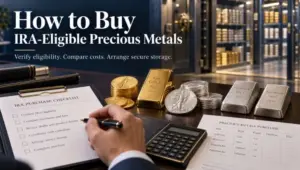
A typical purchase begins with a self-directed IRA custodian that supports physical metals.
- Compare custodians. Request their accepted-product requirements, fee schedule, and storage arrangements.
- Confirm the funding route. Have the custodian explain whether your situation involves a contribution, IRA transfer, or retirement-plan rollover, and which rules apply.
- Obtain an itemized dealer quote. Specify the exact coins or bars and ask for a current resale quote.
- Verify acceptance before purchase. Get the custodian’s confirmation for the proposed products.
- Authorize the transaction through the IRA. Follow the custodian’s payment and documentation process.
- Retain the records. Keep invoices, storage documentation, and account statements together.
STRATA describes opening and funding the account, choosing a dealer, and submitting investment directions as its basic purchase process.
Avoid moving retirement money first and investigating the transaction later. Clarify the account, product, and funding details before authorizing a purchase.
Questions to Ask Before Choosing Your Metals
Use these questions to turn a sales conversation into a clear comparison:
- Why are you proposing this particular product?
- Can you quote a standard bullion alternative?
- What is the total purchase cost for each option?
- What would you pay to repurchase each option today?
- Who is the custodian, and who operates the depository?
- Which costs could change after the first year?
- What happens if I decide to sell only part of the holdings?
Write the answers down. A proposal is easier to evaluate when the product details, costs, and service responsibilities are explicit.
Considering physical gold or silver for retirement? Request a free Gold IRA guide, then use this checklist to compare its information with written custodian and dealer quotes. Ask about eligibility, funding, storage, ongoing fees, and resale terms before making a decision.
Request Your Free Gold IRA Guide Now →
Frequently Asked Questions
What are the four IRA-eligible precious metals?
Gold, silver, platinum, and palladium can qualify when held in eligible coin or bullion form under the applicable rules. Not every product made from those metals qualifies.
Is all 24-karat gold IRA eligible?
No. High purity alone does not resolve product eligibility, custodian acceptance, or custody requirements. Verify the specific item before purchasing it for an IRA.
Why are American Gold Eagles eligible despite their lower purity?
Federal law provides a specific exception for the designated U.S. gold coins. They do not have to qualify solely through the general bullion fineness standard.
Can I contribute gold I already own to my IRA?
Ordinary IRA contributions must be made in cash. Do not treat personally owned coins as an ordinary IRA contribution. The rules for qualifying rollovers are separate.
Does “IRA eligible” mean the government recommends the investment?
No. Eligibility concerns the rules governing what an IRA may hold. It does not establish investment quality, reasonable pricing, or suitability.
What should I do before buying?
Obtain an itemized quote, confirm the exact products with your custodian, review the custody arrangement, and compare purchase and resale prices. Keep copies of the written terms.